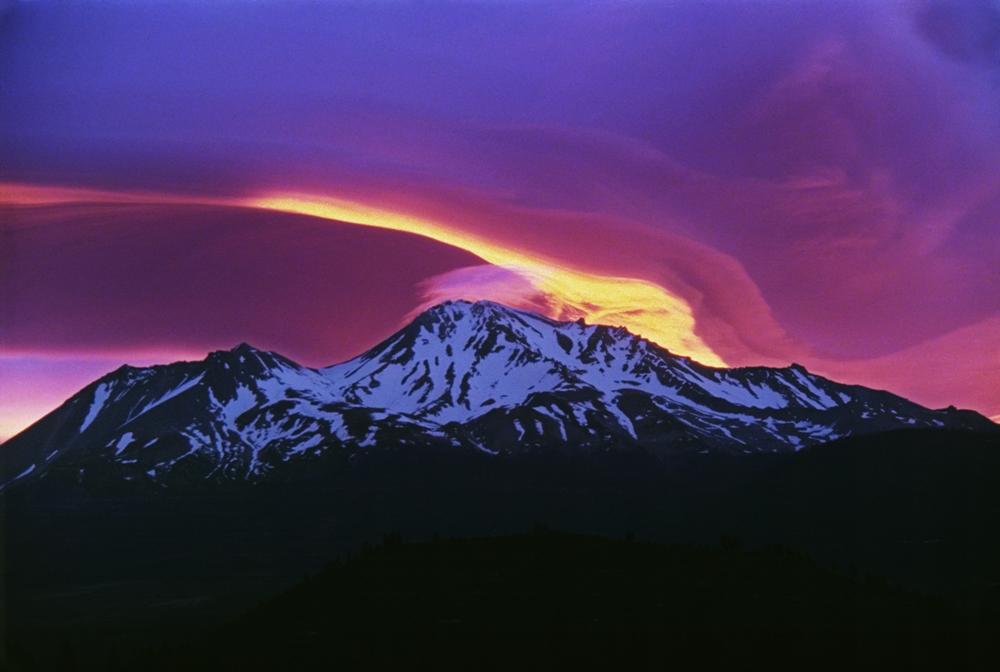
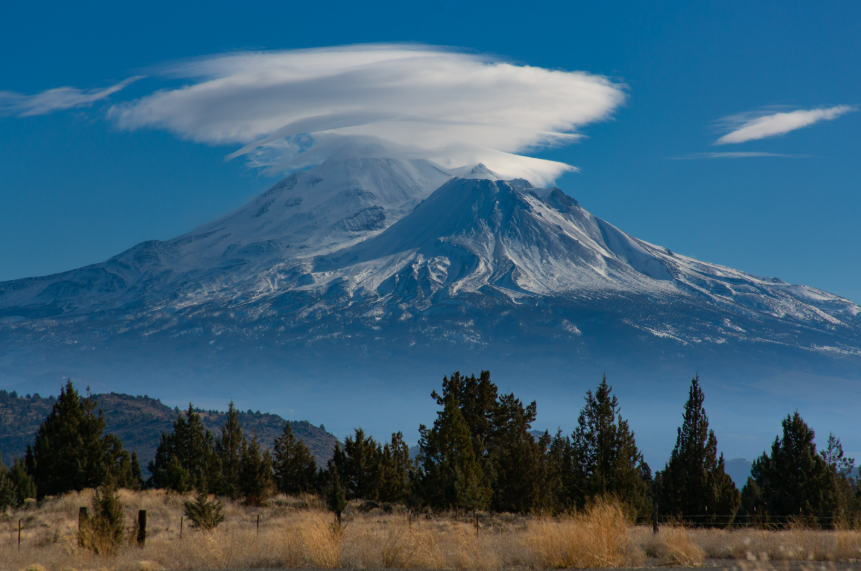
Mount Shasta, an imposing volcano over 4,300 meters high located in Northern California, is much more than a geological landmark. Its solitary silhouette dominates the region’s horizon and, for centuries, has been perceived as a place where the visible and the invisible seem to intertwine. For many visitors, Shasta is not simply a mountain: it is a point of convergence between nature, spirituality, and myth.
It has established itself as one of the most “energetic” and mystical places in North America, a point of convergence where authentic indigenous stories, paranormal interpretations, and <a Theories about lost civilizations. The result is a fascinating mosaic where history, tradition, and myth blend together until they become inseparable.
The Center of the Universe for Indigenous Peoples
Long before Western explorers mapped the mountain or geologists studied its volcanic origin, the indigenous peoples of the region already perceived something extraordinary in Shasta. For the Wintu, Karuk, Shasta, and Modoc tribes, the mountain was not simply a geographical formation: it was a point of contact between the human world and the spirit realm.
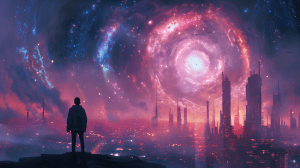
In many of their traditions, Shasta occupies the place of Axis Mundi, the symbolic axis that connects heaven, earth, and the underworld. From this perspective, the mountain functions as a kind of cosmic column through which the energy of the universe circulates.
The Origin of Life: According to Wintu tradition, the creator being called Skell descended from the sky to the mountain’s summit to form the world, create humans, and teach spiritual laws.
The Battle of the Gods: There is a legend about a cosmic conflict between Skell (spirit of order) and Llao (spirit of the underworld), who fought by hurling fire and rocks at each other. This story is how the indigenous people explained volcanic eruptions and geological changes in the area.
The Spiritual Bridge: For the shamans, ascending Shasta was not a hike, but a pilgrimage to the divine. It was the Axis Mundi, an energy ladder where they fasted to detach themselves from the physical body and receive direct visions of beings from other dimensions.
The legend of the "Lemurians" of Shasta
If indigenous traditions constitute the oldest spiritual core of Mount Shasta, modern interpretations have added a whole new layer of mystery.
From the late 19th century and especially during the 20th century, Shasta began to appear in numerous esoteric and theosophical currents. According to these theories, the mountain conceals within it an advanced civilization that survived an ancient global catastrophe.
The concept of Lemuria originally emerged in the 19th century as a scientific hypothesis. Some naturalists proposed the possible existence of a lost continent in the Indian Ocean to explain certain biological similarities between species separated by great distances. However, the most influential theoretical approach was that proposed by Helena Petrovna Blavatsky, who reinterpreted the theory and placed the supposed continent of Lemuria in the Pacific Ocean instead of the Indian Ocean.
Although these theories were dismissed by modern science, they were adopted by other movements such as Theosophy, which reinterpreted Lemuria as an ancient, extremely advanced civilization. In these currents, it is described as the home of one of the first great evolutionary stages of humanity, known as the “third root race.”
According to these modern beliefs, when Lemuria was destroyed by a Following a planetary cataclysm, some of its inhabitants managed to survive by taking refuge underground.
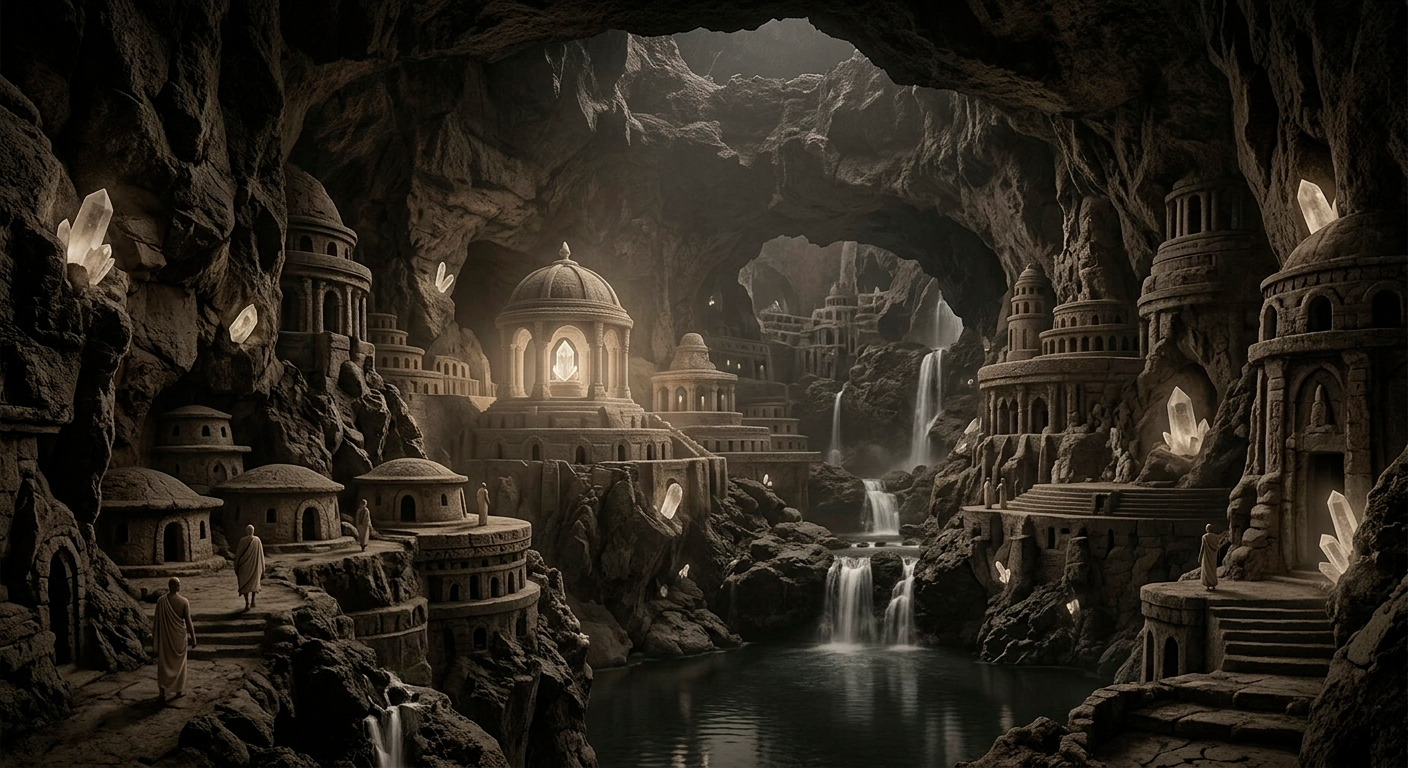
One of the places where they would have built shelters was precisely Mount Shasta, where they would have created an underground city called Telos.
In the accounts, Telos is described as a highly evolved civilization where the inhabitants live in harmony, possess advanced spiritual knowledge, and use technologies based on crystals, mental energy, and vibrations.
@margaritaarnalmoscardo LEMURIA Y EL MONTE SHASTA-Continente perdido o leyenda, Monte Sastha , lugar sagrado o hogar de los lemurianos .#culturaorigenes #feenlahumanidad #misteriosdelmundo #angelesydioses #origenextraterrestreluna #verdadesindigenas ♬ sonido original - Margarita Arnal Moscardo
Those who travel to Shasta do so not for tourism, but because of a calling. It is said that the mountain “calls” you when you are ready for a DNA activation or an awakening of consciousness. On its slopes, time seems to bend, meditations become astral journeys, and dreams are transformed into direct messages from the Lemurian masters.
Mount Shasta stands today as a beacon of hope in a world often disconnected from the sacred.
Whether you see it as the home of the ancient gods or as the refuge of the mystical brotherhood of Lemuria, Shasta reminds us that the Earth is alive, that it holds wondrous secrets, and that we are surrounded by unseen dimensions waiting to be explored.
Regardless of skeptical interpretation, Mount Shasta remains a universal symbol of the global pattern of “sacred mountains” (such as Mount Kailash in Tibet or Mount Sinai) that act as bridges between what we see and what we intuit exists beyond.