

Gunung Padang, whose name means “Mountain of Light,” is one of the most mysterious structures on the planet, even more intriguing than the archaeological site of Göbekli Tepe. Located on the island of Java, Indonesia, this formation has captured the attention of archaeologists, geologists, and alternative history experts due to its surprising antiquity and complex architecture.
Certain experts such as Victor Luis Perez García have conducted studies on this enigmatic location and its influences on human civilization, finding surprising parallels with the first Egyptian pyramids, a fact that has led many people to theorize whether it truly is an ancient site comparable to the lost city of Atlantis described by the philosopher Plato.
What is Gunung Padang?
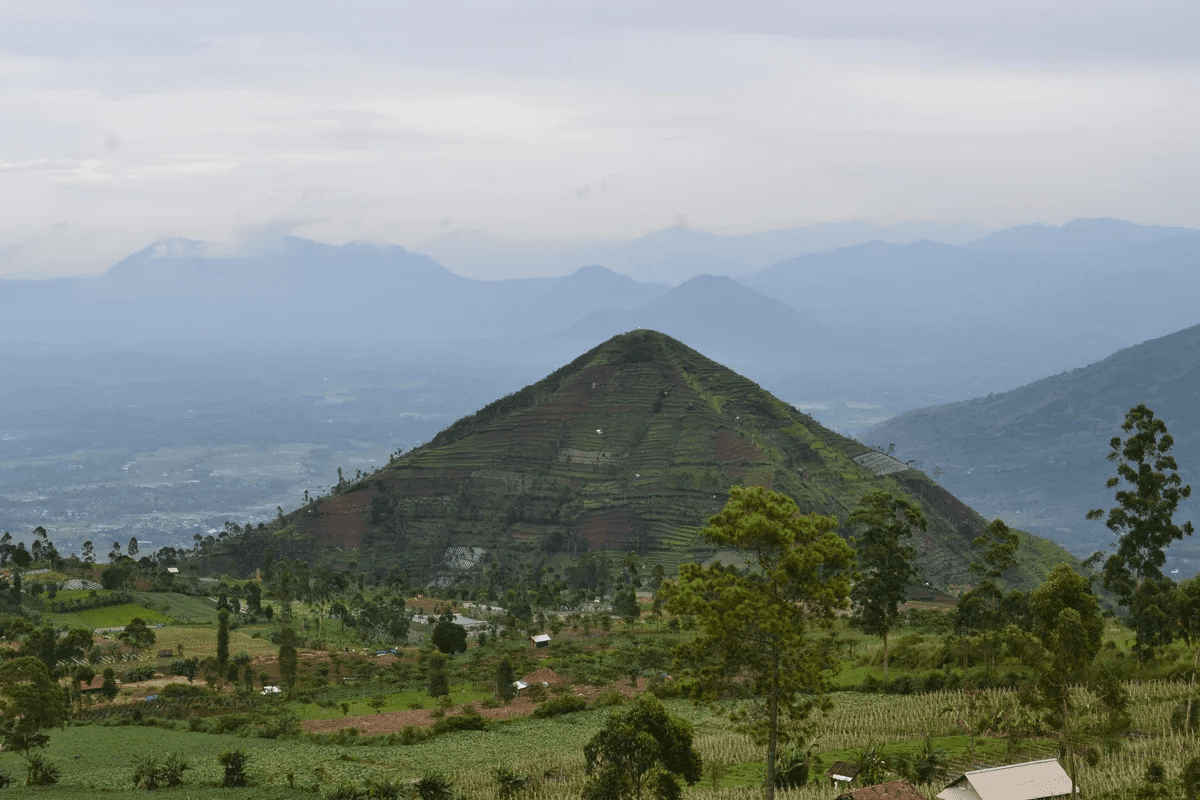
Gunung Padang is a megalithic complex composed of stepped terraces, built on an extinct volcano. Recent research suggests that its origin may date back 26,000 years, making it the oldest known megalithic structure in the world.
Its visible surface covers approximately 3,000 square meters, but studies using ground-penetrating technology reveal that there is much more underground.
According to studies conducted by Indonesian experts such as Danny Hilman Natawidjaja and other international researchers, Gunung Padang was built in at least four distinct stages, demonstrating an architectural evolution over millennia:
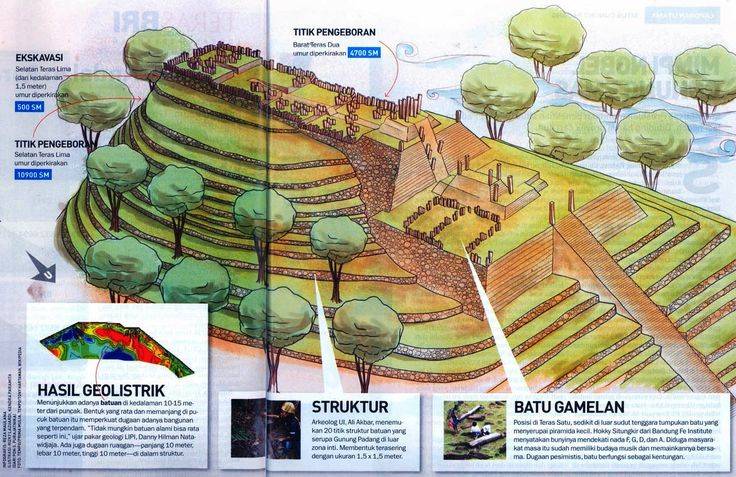
First stage (approx. 25,000–22,000 BC):
The core of the hill was originally a natural lava formation, which was sculpted and shaped by human hands. This phase forms the basis of the entire structure.
Second stage (around 7900–6100 BC):
New terraces and walls are built on the hill.
Third stage (around 5500 BC):
One of the oldest units was deliberately buried, possibly to preserve knowledge or perform rituals.
Fourth stage (around 2000 BC):
The last visible platform (Unit 1) is erected, covered with large hexagonal volcanic andesite stones. This unit is currently the most accessible and requires climbing 375 steps carved into the rock.
Advanced technology reveals the mystery beneath the surface
Thanks to technologies such as LIDAR, ground-penetrating radar, seismic tomography, and electrical resistivity, it has been possible to observe the complex architecture hidden in the lower layers of the site. These tools have confirmed the existence of retaining walls, internal staircases, and hidden chambers, some of them built with columnar basalt arranged in horizontal and inclined layers, which is anomalous in nature, where such formations are usually vertical.
These configurations suggest deliberate and planned human intervention in the environment, and not merely a geological formation.
Despite evidence from carbon-14 dating and geological studies, mainstream archaeology remains skeptical. Some experts argue that Gunung Padang is simply a superficially modified extinct volcano, and that the visible structure dates back no earlier than the 2nd or 8th century AD.
One of the main arguments of orthodox criticism is that the oldest subsurface datings are not associated with direct cultural artifacts, so it cannot be confirmed that the structure is as old as the layers where it is found.
@margaritaarnalmoscardo GUNUNG PADANG #crecimientopersonal #TAROT #BIOENERGIA #MEDITACION #VISUALIZACION #psiquicas #ZEN #VIDENCIA #HISTORIA #REENCARNACION #TIBET #VIAJEASTRAL #TAROTEGIPCIO #MARGARITAARNAL #ENERGIA #OVNIS #MEDIUM #CALENDARIOMAYA #profecias #biblias #gununpadang#margaritaarnal
♬ original sound - Margarita Arnal Moscardo - Margarita Arnal Moscardo
Even with the controversy, the Gunung Padang site opens the door to a key question:
Did an advanced civilization exist long before official history recognizes?
The similarities with other megalithic sites, the precision of their structures, and the technological sophistication required for their construction, suggest that our ancestors were not as primitive as previously thought.
Many articles, such as the one proposed in muyinteresante.com, propose the theory that millennia ago, two types of humanity coexisted: one technologically advanced and the other more rudimentary, which would explain certain inconsistencies in the traditional historical account.
Gunung Padang could become the key to redefining the chronology of human civilization.
If research continues and the evidence is confirmed, we could be looking at the oldest archaeological site on Earth, which would force us to rewrite many chapters of history that we take for granted today.
Bibliography of interest on Gunung Padang
Victor Lluís Perez Garcia (2017) “Gunung Padang and Indo-Malay megalithism: Archeology and pseudoarchaeology”, in https://www.researchgate.net/publication/374701393_Gunung_Padang_y_el_megalitismo_indo-malayo_Arqueologia_y_pseudoarqueologia
Ess Open Archive (2025) “Artículos varios de arqueología”, en https://essopenarchive.org/
Danny Hilman (2010) “Professional profile and published works”, Independent Academia, at https://independent.academia.edu/DannyHilmanNatawidjaja
IBM (2023) “What is Lidar”, in https://www.ibm.com/es-es/think/topics/lidar
KREASI HANDAL SELARAS (2020) “[HSG Survey & Mapping] Gunung Padang Cianjur LiDAR & Photogrammetry
“, en https://youtu.be/3dyyxNRCYWQ
Eugenio M. Fernández Aguilar (2024) “A team of scientists shows that two human species shared the same place 1.5 million years ago
“, in https://www.muyinteresante.com/historia/huellas-de-dos-especies-humanas-en-simpatria-hace-1-millon-de-anos.html


